found drama

get oblique

dream.20130212: R REPL

by Rob Friesel

You are trapped inside a hollow sphere. A fluorescent glowing white all around you. Except for dashes of color and black smudges. Not smudges. Text. Everywhere you turn, an R REPL follows you. And it vomits a never-ending cascade of commands. A convoluted combination of sapply and gsub. svd. plot. table and summary. plot, plot. smoothScatter. is.na. plot, plot, plot

Linkdump for February 9th

by Rob Friesel
  • Mat Honan at Wired.com's Gadget Lab blog:

    And that’s the thing: Flickr feels like a permanent home.

    Pretty much how I've felt about it all along. (Via DF.)

    (tagged: Flickr )
  • Dr. Axel Rauschmayer with the CSS4 selector "highlights". Specifying the selector's subject looks pretty awesome (though I wonder how that will perform in early iterations?) and being able to style on UI states will also be quite nice. (Not sure I understand the :scope selector sugar yet though.)
    (tagged: CSS4 )
  • "Timeline is the new Network panel." Addy Osmani with an informative post on how to use the Timeline panel in Chrome's DevTools to inspect your pages to find strategies for dealing with repaints and improving your scrolling FPS.
  • John Resig posts an interesting tip on how to keep sensitive information in source control with encrypted files. (And/but: I'm a fan of the idea he leads off with, as well: don't keep them in source control to begin with.)
  • "A tooltip library in CSS." Pretty slick how he did this. Color me impressed (though a little bit of nose-crinkling about the choice of BEM).
    (tagged: tooltips CSS )

Linkdump for February 3rd

by Rob Friesel
  • Ovetta Wiggins, The Washington Post:

    A proposal by the Prince George’s County Board of Education to copyright work created by staff and students for school could mean that a picture drawn by a first-grader, a lesson plan developed by a teacher or an app created by a teen would belong to the school system, not the individual.

    Despicable.

    (tagged: copyright education )
  • Jessica Lahey, writing for The Atlantic. Not as "fun" as the "Please Don't Help My Kids" article, but in the same vein.

    However, I did take slight issue with this:

    We teach responsibility, organization, manners, restraint, and foresight.

    No. I teach those things to my kids; I expect you to expect me to do that teaching.

    (tagged: parenting )
  • If asked to boil it down to a single catch phrase, it would probably be:

    …events are essentially the only variable…

  • Fun little post about numbers and parseInt in JavaScript by Dr. Axel Rauschmayer. In retrospect, some of these should seem obvious given the size of the numbers we're talking about here. Anyway… I'm a sucker for this sort of trivia.
    (tagged: JavaScript )
  • Professor Jeff Leek, writing at his blog Simply Statistics:

    Of course that is a ton of material for 8 weeks and so obviously we will be covering just the very basics.

    I wrapped up the first week of the course on Thursday (1/24). So far it has been a bit intense, but also fun. So far the format and lectures have been good, and I'm (re-)learning quite a bit. I have some stats background from college, so some of it has been review, but it has been fascinating to hear about statistics from other perspectives — I'd never really considered how an economist or biologist or engineer might use those tools. That has been very valuable.

search term haiku: January 2013

by Rob Friesel

evergreen Jasmine
Agile for the introvert
a cartoon whale mouth

“Search Term Haiku” is a series wherein I examine this site’s log files and construct one or more haiku poems from search terms and phrases that led visitors to the site. Where possible, I attempt to keep the search phrases intact. However, as these are haiku poems, I do need to follow the rules.

LOL charsets

by Rob Friesel

Or: an almost certainly incomplete but hopefully accurate enough (and succinct) front-end developer’s guide to charsets and character encoding.

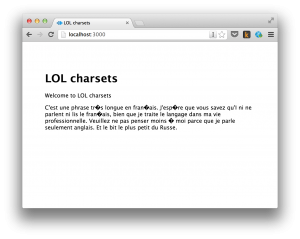
Before we begin, I will summarize the problem with the following picture:
LOLcharsets

Do you see those funny diamonds with the question marks in them? That’s about the size of the problem, right there. 1 You have some text for your French-speaking customers, but without the right instructions the computers between you and your customers are too stupid to know that some series of numbers are going to need to display as a ç and not as… something unattractive.

Now, before we get in to any of the details, here’s the spoiler alert for the rest of this post: Just pay attention to the charset(s) that you use — those are the “rules” for how your computer (and every other computer) is going to convert “the numbers” into “the letters”. Remember to be explicit about which charset to use (the whole way down the line!) and hopefully you can save yourself a little embarrassment and frustration. Continue reading →
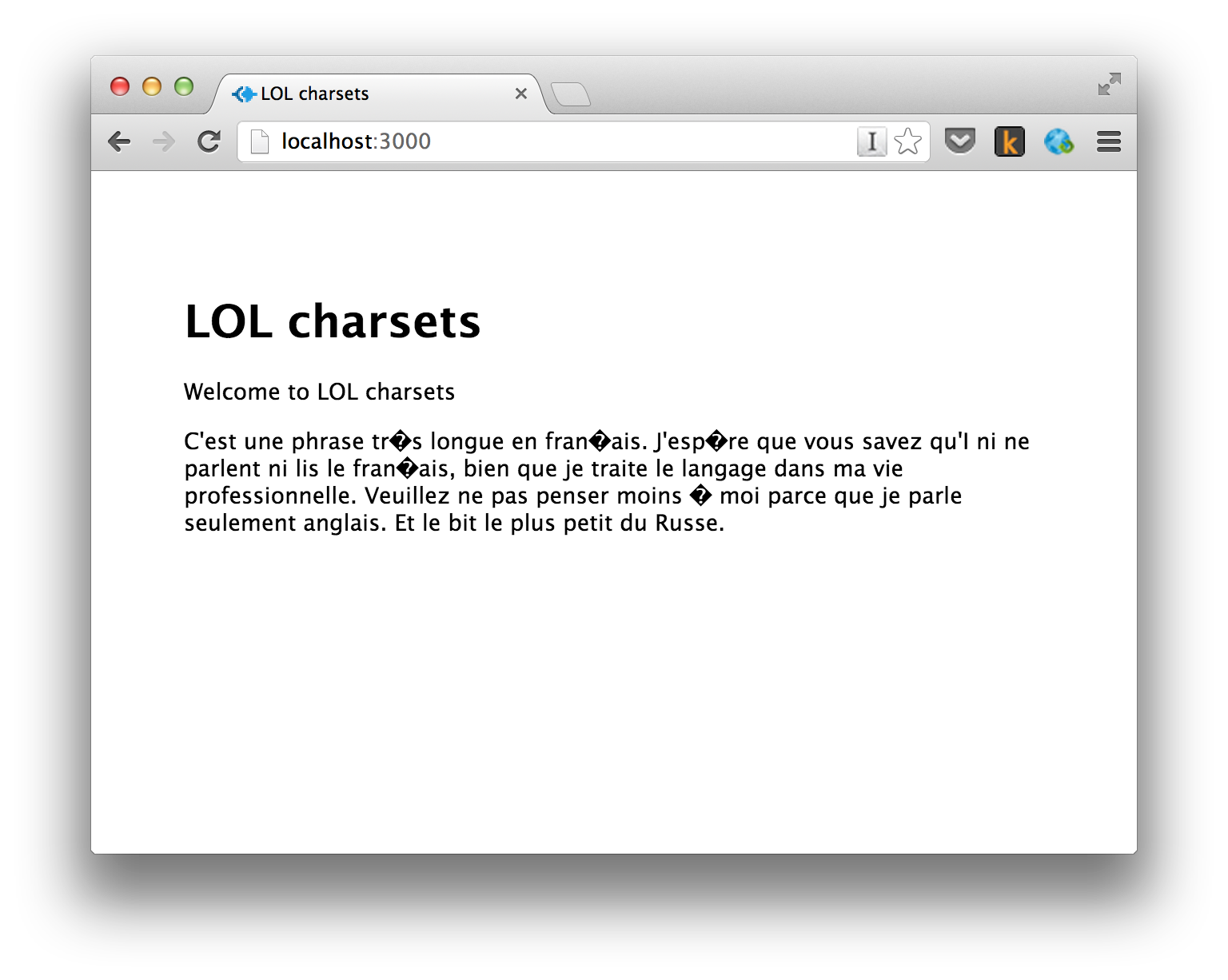
  1. If you are interested in the technical details behind the example: that page is being served by a simple Express.js app with a Content-Type header that specifies text/html; charset=UTF-8, but the file itself (an EJS template) is saved to disk as ISO-8859-1 (Latin-1). And TJ-only-knows what happens in the conversion process between when the route passes the model to the template and when the generated mark-up actually goes out as the body of the request. (And yes, I intentionally created the charset mis-match for illustrative purposes.)[]

Linkdump for January 26th

by Rob Friesel
  • Ari LaVaux, writing for Slate Magazine. tl;dr: It's OK to buy quinoa, just do everyone the favor of looking for Fair Trade, sustainably cultivated quinoa.
  • Shane Tomlinson, with a great post on the anti-patterns (and patterns cum anti-patterns) that make so much front-end code so difficult to test. Some of these observations are obvious (e.g., how it's basically impossible to write automated tests for inlined scripts) but others have much finer points on them. In particular, I was drawn to his discussion of how the abuse of IIFEs for "privacy" and "security" (without exposing anything through the module pattern) is almost as bad as inlining all your code. Granted, he provides a solution — but relying on a pre-processor to strip out marked members of the module seems… specialized, brittle, and untenable. Just the same, it's a worthwhile read. (Also: I loved his phrase "Pyramid of Doom".)
  • A presentation by Dale Sande to go along with his post (see below) on the subject.
    (tagged: Sass webdev SCSS CSS )
  • Dale Sande:

    A developer never sets out with the goal of making a complete and total mess of things.

    In some ways it's a bit of a "me too!" post about how to organize your stylesheets (e.g., somewhat more opinionated than SMACSS, a lot more opinionated than OOCSS) but still worth the read, even if you're feeling burned out on this kind of advice. Sande's proposal is to take a bottom-up/inside-out approach to engineering your (S)CSS and to organizing your directories and files. The key take-aways for me were: (1) the opinionated directory structure and (2) treating style.scss as a manifest for everything else. (Though the second item is hardly a new idea, talking about it as a "manifest" is certainly an elegant expression of that idea.)

    There are still some unsolved problems here, but they're mostly social. ("How do I create the right traction for this work in a big organization? and/or reduce the friction for working within a big application?")

    (tagged: Sass webdev SCSS CSS )
  • Fantastic piece by Alexis C. Madrigal, writing at The Atlantic. It's short, but dense — he goes into a bit here about health, fitness, and urban planning. The article made me nostalgic for when I lived in downtown Burlington and walked to and from work every day. (Which sends me on little mental digressions about these choices we make re: where we can afford to live, where we work, where we want our kids to grow up and go to school etc.)

    Who would have thought that an 850 word article about pedometers and walking could get you thinking about so many things?

dream.20130126: in the caves

by Rob Friesel

She returns unexpectedly. Unannounced. She is laden with some package, something wrapped and concealed. A burden. She has been gone for years — almost as long as you have lived here — and not a word from her in all that time.

Your son, who was just a baby when you all found the caves and moved into them, is now old enough to have pointed questions about this stranger. Who is she? And where did she come from? Why has she come here? What is under her arm? He is nervous and scared and probably rightfully so. (He looks more like his mother now than when he was a toddler bumping his head on the cave walls.) Continue reading →

Linkdump for January 24th

by Rob Friesel

Linkdump for January 18th

by Rob Friesel
  • John Resig on internationalizing a Node/Express app. If you've never internationalized an application before, it's a pretty good survey of the intricacies and techniques and worth the read. I'm a little skeptical about using sub-domains for different languages — especially if you're already planning to use the Accept-Language header — but there's something to be said for simply using your output phrases as your keys. (Although I wonder about how you would manage tokenized strings as your keys…)
  • The new jQuery Plugin Registry has launched. Looks pretty sweet. I'm optimistic that this will catch on as the canonical source for jQuery plugins, and that the jQuery Foundation can drum up enough volunteers to keep this thing relevant and fresh.
    (tagged: jQuery )
  • At InfoWorld.
  • Jafar Husain, Senior Developer at Netflix:

    The Reactive Extensions library models each event as a collection of data rather than a series of callbacks. This is a revolutionary idea, because once you model an event as a collection you can transform events in much the same way you might transform in-memory collections.

    I haven't watched the interview yet, nor worked through the interactive tutorial, but I'm very intrigued by this idea and want to give it a further, in-depth study.

  • By Julie Miller Vick and Jennifer S. Furlong, for The Chronicle of Higher Education. The article is oriented more toward academics and academia, but many of these suggestions/resolutions are excellent no matter what your field is. I particularly liked number 5.
    (tagged: resolutions career )