found drama

get oblique

Linkdump for December 20th

by Rob Friesel
  • Louis Lazaris at Impressive Webs. I'd somehow missed this — that Internet Explorer 10 was not going to support conditional comments. (Probably because I don't pay enough attention to IE-related news?) Conditional comments were only ever "the least hacky" way of dealing with ID's quirks — and though "a hack is a hack" (and thus should be avoided), it was still at least a reliable and relatively unobtrusive way to get the job done.

    Alas — with IE10 ("and above") this means we're up against this problem again. In this post, Lazaris demonstrates three methods for coping with IE10. Unfortunately, they all smell of brittle hacks. As usual: tread carefully.

  • Looks like some nice updates to mod_pagespeed. (As an aside: hopefully this fixes the recent conflicts with WordPress 3.5 and its script concatenator/loader…)
  • Ilya Grigorik (one of 2013's "devs to watch", if you ask me) with a sane and forward-thinking proposal about how we can improve the ways that we serve images on the web. A little long, but worth the read. Best part? The solution is to use HTTP, and not to try to shoe-horn more features into HTML.
  • "Block-Element-Modifier"… to join the ranks of OOCSS and SMACSS?

    The value proposition was not immediately obvious to me ("So… it's like a more strict or more structured version of SMACSS?") and as such I feel like I need to use it and/or meditate on it a bit before I can form a real opinion. But there's a decent summary here (including the comment thread).

    (tagged: BEM SMACSS OOCSS CSS )
  • John Albin Wilkins (writing at Palantir.net) breaks it down re: all the nasty little rounding errors that can occur in percentage-based fluid layouts. There are some strategies in here for dealing with those problems (e.g., border-box, zen grids) but ultimately what it comes down to: make more (or different) compromises. Also cheat.
  • An awesome little JavaScript library by Larry Battle for working with ratios, fractions, and rational numbers. This is timely (for me) because I was just reading about ClojureScript and lamenting how CLJS doesn't have the same venerated support for rationals as Clojure does. And it isn't so much that this solves that problem "for free", but at a minimum it shows how one might go about dealing with that.

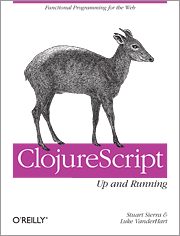
review: ClojureScript: Up and Running

by Rob Friesel

ClojureScript: Up & RunningAn (apocryphal?) tale: 1 when Brendan Eich unveiled the original JavaScript (nee LiveScript, nee Mocha) prototype at (then) Netscape, it was a Lisp. 2 It was only at management’s insistence that the language received a C-like syntax, and even then it was mostly to have some kind of syntactic parity with Java (with which it was supposed to provide some “glue”). Now: if you think about JavaScript using this lens, then it is easy to conjure up images of ClojureScript as “the JavaScript that could have been”. 3

And that is exactly what we have in Sierra and VanderHart’s ClojureScript: Up and Running — a guided quickstart to the language that JavaScript could have been. And what an interesting little language it is! Continue reading →

  1. The best source I could come up with to back up my point was this post on Dr. Axel Rauschmayer’s blog. But how much source material do you really need for fun little bits of apocrypha anyway?[]
  2. Or at the very least, it was “Lisp-like”.[]
  3. I wonder: if JavaScript had been a Lisp all along, would we be having the whole “assembly language of the web” conversation at all?[]

Linkdump for December 17th

by Rob Friesel
  • At dataist.

    tl;dr: Here's how to set up your Google Spreadsheet. Here is how to publish the data as ATOM. Here is how to transform the ATOM data to JSON. Now go ahead and feed that into your data visualization library of choice. (Albeit, you may need to munge it a bit.)

    See also: tabletop.js.

  • Exactly what the title says.
    (tagged: Git )
  • Great post by Paul Umbers (writing at Internistic) re: getting started with Clojure in Sublime Text 2. As he states right off the bat, Emacs provides a significant barrier to entry to a lot of folks that want to dive in and explore Clojure, and using Sublime Text 2 takes a lot of the initial effort out the equation for a lot of people.

    That being said: you're going to need to get the REPL up and running (there's no better way to learn Clojure than to tinker with it in the REPL!) and there's a good chance that you'll get an error about "No such file or directory" from Sublime Text. Refer to this issue in GitHub to solve that problem.

    (tagged: SublimeText Clojure )
  • John Downey, writing for the Braintree Payments dev blog. Regardless of whether you're pro-REST or not, his is an interesting take on the rationale to provide language-specific client libraries instead of "simply" opening up a RESTful API.
    (tagged: HTTP API REST )
  • I'm not going to io9 for my science reading, but I imagine I'll find myself doing some follow-up reading after this. I do love me some bread and pasta, and/but maybe I might benefit from turning the gluten volume down?
  • I haven't read any of Anil Dash's posts in a good long while, but this one is thoughtful and worthwhile, and most of his points really ring home with me re: why I've kept blog.founddrama.net going for so long instead of letting it lapse into the DNS dustbin while I move my "online identity" into Facetwittergramterest etc. (Also: I'd pretty much forgotten all about Technorati… talk about the web's Memory Lane.)
    (tagged: internet culture )

Linkdump for December 14th

by Rob Friesel
  • In case you need to worry about this sort of thing: here's the MSDN doc that breaks down the differences between "real IE10" (on Windows 8) vs. the Windows 7-compatible IE10 "Release Preview".

    tl;dr: Unless you're dealing with touch events, and some of the -ms-vendor-prefixed stuff, you're probably fine.

  • Nice write-up by Todd Kloots at the Twitter Engineering blog about their pushState implementation, and some of the pitfalls to watch out for when mucking around in those APIs on your own time.
  • Scott Hanselman (back in 2011) dinging &yet; over their "&!" product, and how they handled browsers that don't handle WebSockets. For the most part, Hanselman's headline is right on but…

    …commenter David Carson more/less summarized my true feelings on the matter.

    The web has become a powerful platform for delivering high quality software, but front-end developers everywhere recognize that it's not a level playing field. Yes, there are shims and fallbacks and polyfills. Yes, there are ways of progressively enhancing your offering. But there's also a point where you should be able to say: "This is high-quality software, and these are the requirements."

    Sometimes you need to make that choice. And in &yet;'s case, and especially in the case of &! — I think that they totally made the right choice. They chose the features they wanted to deliver and focused on those. (And I'm pretty sure it was just a prototype at the time Hanselman wrote this blog post.)

  • Emma Marris, writing for Slate:

    “It feels more responsible and ecologically sound to eat an animal that was raised wild and natural in my local habitat than to eat a cow that was fattened up on grain or even hay, which is inevitably harvested with fuel-hungry machines,” writes Christie Aschwanden, a self-described “tree-hugging former vegetarian.”

    Also:

    [All] it takes is overturning two long-held beliefs among many urban liberals: that it is wrong to personally kill animals and that hunters are all rural conservatives.

    (tagged: hunting )

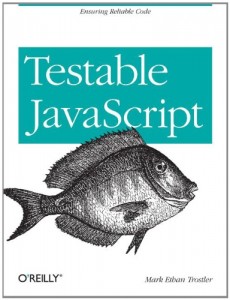
review: Testable JavaScript

by Rob Friesel

Testable JavaScriptRight off the bat, and just so we’re clear about this: I read an “Early Release” edition of Mark Ethan Trostler’s Testable JavaScript, and in a lot of places… it shows. I’m sure it will come through editing and be a lot tighter by the time you read it. 1

Putting its rough “Early Release” nature aside, I had some mixed feelings about this book. I’ll try to explain it as follows:

Rebecca Murphey (@rmurphey) did a talk during the 2012 JavaScript Summit (put on by E4H) which was titled “Writing Testable JavaScript”. 2 Early on in that talk, she impressed upon us that she was going to talk about how to write testable JavaScript, and not how to write JavaScript tests, nor how to test JavaScript. These are important distinctions. Writing tests (in a way) is this weird hybrid of somehow both writing more code and writing documentation. And testing your code is … well, it’s the act of putting your code through the accompanying tests to see if they pass muster. But writing testable code is about adopting a certain style wherein your code becomes easier to test as a consequence of that style. And the argument goes that if your code is easier to test, then it will also be easier to reason about. (Insert functional programming rant here.) Continue reading →
  1. I promise?[]
  2. The slides for her talk are available on Speaker Deck. See also: portions of Nicholas Zakas’ Maintainable JavaScript talk.[]

Linkdump for December 6th

by Rob Friesel

Linkdump for December 3rd

by Rob Friesel

Linkdump for November 26th

by Rob Friesel