found drama

get oblique

Linkdump for May 17th

by Rob Friesel

BurlingtonJS #2

by Rob Friesel

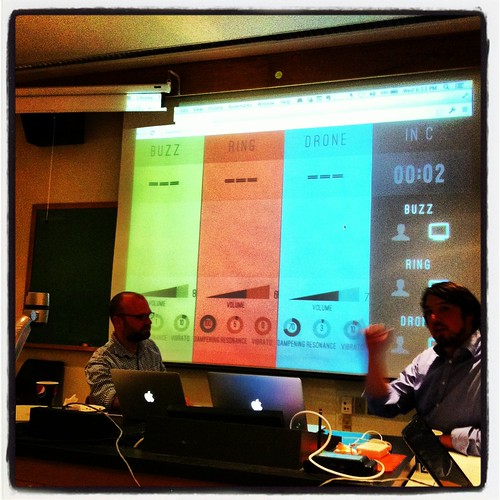
Last night was the second BurlingtonJS meet-up and once again it felt like a huge success. Many thanks again to Patrick and Pete for organizing it; there was a great turn out and a lot of great discussion. The theme of the night was Node and the presenters did a fantastic job. First up, Dave Howell and Jeffrey Pierce (pictured below) presented on their “all JavaScript” rendition of Terry Riley’s In C (“in.c”), with special attention paid to the library they wrote to wrap the Web Audio API and the pain and suffering involved in synchronizing the audio context’s clock with the canvas context’s clock. Next up was Jon Sullivan, giving a high-level overview of how Node fits in to the technology stack at Mindflash. The meet-up had a great turn out, the conversations were great, and I think every attendee got something useful (or at least fun) out of the night.

demo of "in.c"

Dave and Jeffrey (Pixel to Noise) demo “in.c” (source). (Photo originally posted to Instagram.)

Continue reading →

Linkdump for May 14th

by Rob Friesel
  • Roland Kelts, writing for The New Yorker:

    Rubin said that the first time he translated a Murakami novel, The Wind-Up Bird Chronicle, he phoned the author several times a day to nail word choices and correct inconsistencies. “In one scene, a character had black-framed glasses. In another, the frames were brown. I asked him: Which one is it?” I found Rubin’s anecdote revealing. The Japanese language acquires much of its beauty and strength from indirectness—or what English-speakers call vagueness, obscurity, or implied meaning. Subjects are often left unmentioned in Japanese sentences, and onomatopoeia, with vernacular sounds suggesting meaning, is a virtue often difficult if not impossible to replicate in English.

  • By Jon Brisbin, writing at the SpringSource Team Blog. See the comments section for the answers to some of the obvious questions comparing it to Vert.x.
  • Jeffrey Toobin, writing for The New Yorker:

    It’s important to review why the Tea Party groups were petitioning the I.R.S. anyway. They were seeking approval to operate under section 501(c)(4) of the Internal Revenue Code. This would require them to be “social welfare,” not political, operations. There are significant advantages to being a 501(c)(4). These groups don’t pay taxes; they don’t have to disclose their donors—unlike traditional political organizations, such as political-action committees. In return for the tax advantage and the secrecy, the 501(c)(4) organizations must refrain from traditional partisan political activity, like endorsing candidates.

  • Mat Marquis (Filament Group) interviews Paul Irish (Google) over at A List Apart.

    We carefully gauge real-world usage of things like CSS and DOM features before deprecating anything. At Google we have a copy of the web that we run queries against, so we have a pretty OK idea of what CSS and JavaScript out there is using.

    (tagged: Blink Google Chrome )
  • Tyler Sticka, writing over at the Cloud Four blog, offers up a round-up or field guide of the styleguides, boilerplates, etc. that are out there — including a spreadsheet to organize the patterns he found.
  • Burke Holland, writing at the Kendo UI Team Blog.

dream.20130514: keys

by Rob Friesel

The whole gang is making an exit from the office — en masse, all at once, a big crowd of them wandering the labyrinthine halls. (Though somehow the office has no roof? or is already outside?) You find yourself smack in the middle of the throng, taking in the small talk, which mostly revolves around resolving who is driving and/or who is riding with whom. BL turns to you and asks (jokingly?) if you want to trade cars for the day. (“We’ll switch back when we leave from there.”) But he already has your keys. He borrowed them yesterday when he borrowed your car yesterday, and you can’t tell if he’s playing dumb or genuinely doesn’t remember. “There’s no way I have them–” (he insists) “–just run back and grab them. Meet us in the parking lot.” Do you jog back? Is it a trick on top of a trick? An annoyance wrapped up in an honest mistake? Through a window, you can see your car, but as you pat down your pockets–regardless of what he might otherwise be saying–you are certain that you do not have your own keys.

review: Programming Grails

by Rob Friesel

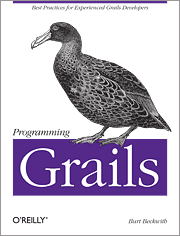
Programming GrailsIf you’ve been programming in Grails for a year (give or take) and are ready to go deeper than the tutorials and docs usually take you, then Burt Beckwith’s book — Programming Grails (O’Reilly, 2013) — is going to feel like just what the doctor ordered. If asked to sum it up as a pithy one-liner, I’d describe it as a guided tour of the framework’s guts by one of the field’s seasoned experts. He goes beyond the basics, and dives headlong into those dark corners for (as he puts it) “developers who want to dig deeper into the architecture and understand more about how Grails works its magic”. Continue reading →

Linkdump for May 10th

by Rob Friesel

dream.20130507: shots fired

by Rob Friesel

You duck and the bullets whizz overhead. Where are they coming from? Another shot rings out. This one hits someone behind you. You watch his body twist and go down. Another shot. Another crumpled body. Everyone is scurrying right now. Through the parking lot (parking lot?) — zig-zagging between cars and trying to duck into the library. (Library?) You’ll be safe in there. Right? Only if you stay away from the windows. You’re in there not two minutes when the first window shatters and someone else goes flying into the stacks. Books fly everywhere. (There is shockingly little blood.) The next shot barely misses you. Where are these shots coming from? They sound like they’re coming from so far away but… Another person goes down. You’re by the ext now. On the far side of the library. You should be safe. But the moment you step from the door another shot whizzes by. (They’re all coming from the same direction, but no matter what you put between you and the presumed source, the shooter seems to have a clear shot.) You take off running. You zig-zag some more. It’s dangerous to head in a straight line. There’s a mountain ahead. Not too far off. If you can get to it, get around the other side of it, then maybe you’ll be safe. But you zig when you meant to zag and the next one catches your leg.

Linkdump for May 6th

by Rob Friesel

review: JavaScript Testing with Jasmine

by Rob Friesel

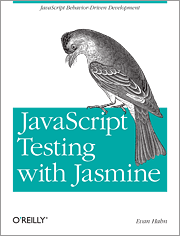
JavaScript Testing with JasmineEvan Hahn did us a favor and slapped together this primer for us: JavaScript Testing with Jasmine: JavaScript Behavior-Driven Development (O’Reilly, 2013). It’s short (around 50 pages), so you can burn through it in an afternoon, but he hits the high notes and (most importantly) provides a clear path for how to get started using Jasmine. Continue reading →

search term haiku: April 2013

by Rob Friesel

vinyl record grooves
headless browser test primer
a fetish airline

Also, I’d like to point out that while combing the data for this past month, I encountered the strangest (or at least most disturbing) search phrase yet: 3D dinosaurs fuck each other. Serious case of “what is this I don’t even” right there.

“Search Term Haiku” is a series wherein I examine this site’s log files and construct one or more haiku poems from search terms and phrases that led visitors to the site. Where possible, I attempt to keep the search phrases intact. However, as these are haiku poems, I do need to follow the rules.